

Blog

Finding Your Highest and Best Use of Time
Often, when referring to time management and its improvement, we hear the old adage of a jar to be filled with sand, pebbles, and rocks.
If you start by adding the sand first, and then the pebbles, the rocks won’t be able to fit inside the jar. There simply isn’t any space left. But if you start with the bigger rocks, then add the pebbles, you can pour in the sand to fill in all the space in between. This representation demonstrates that when we choose the right priorities, we can indeed fit everything necessary into the time container given.
As business owners and leaders, time management is one of the most valuable skills you can practice. There is only so much time in each day, each week, and each month, so finding your highest and best use of time is key to success.

What is the Highest and Best Use of Time?
Highest and best use of time refers to directing your energy, focus, and efforts towards the most appropriate possible task. Ideally, you want to prioritize the activities that will create the greatest impact for your business goals and vision.
Rather than staying busy or constantly reacting to demands, focus on generating the highest value for your team, clients, and organization. Prioritize that above all else, no matter what tries to steer you off-course.
To know if what you’re doing is a distraction, ask yourself if it’s congruent with your purpose and passion.
Are you using your time and resources to contribute to your vision?
Are your actions aligning with your goals?
If you can answer “yes” to both, then you are following the highest and best use of your time.
Operating from your highest and best use of time requires clarity, intention, and discipline to delegate, defer, or eliminate lower-value tasks so that your time is used wisely. One way to determine what the highest and best use of your time is by using the Urgent-Important Matrix.
The Urgent-Important Matrix
The Urgent-Important Matrix is a 2x2 chart also known as the Eisenhower Matrix. It was developed by Dwight Eisenhower, the 34th President of the United States. This matrix is made up of four quadrants, each representing a different level of combined urgency and importance.
In a nutshell, you can use this matrix to determine what needs to get done immediately, what can be delegated, and what can be deleted.
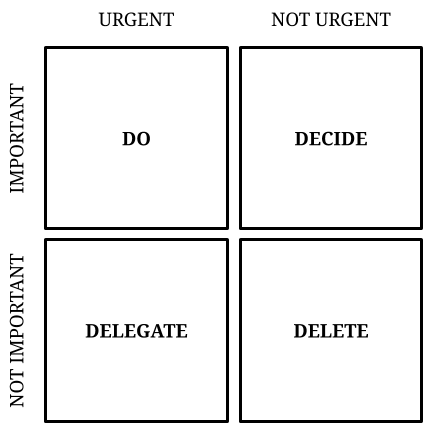
Quadrant 1 is where the most important and most urgent tasks fall into. They’re serious, demanding, and time-sensitive. These tasks need to be done immediately, regardless of who completes them.
Quadrant 2 is for important, but less urgent tasks. These are overhead tasks that are high-value, but don’t necessarily have time constraints. These tasks require your decision-making expertise.
Quadrant 3 is for urgent, but not very important activities. These are smaller tasks that need to be completed, but don’t require major decision-making or executive input. These can be delegated across your team.
Finally, Quadrant 4 is for unimportant tasks that are not urgent. They might include daily habits, tasks that don’t make a huge difference in the business, or aren’t serious concerns. If they aren’t contributing to your business’ overall growth or development, delete them.
As a business leader, you never want to be in Quadrant 4. Instead, the bulk of your work should fall into Quadrant 2.
You want to be working on decisions, operations, and overall strategy that contribute to the overall growth of your business. This is the “big rock” work of the time management jar - planning and organizing of the business itself.

Common Mistakes with Finding Your Highest and Best Use of Time
In business consulting, we see these three typical mistakes that business owners make when trying to prioritize their highest and best use of time. It often comes down to: getting lost in the weeds, focusing on busy work, and feeling like you have to do it all.
The good news is that once you can catch yourself making a mistake, you can choose differently. Here are the three common mistakes and what you can do about them.
1. Getting Lost in the Weeds
As a business owner, you want to focus less on the daily demands of your business and more on its overall growth and development. That means delegating certain tasks so you can focus on strategy.
What often happens is that business owners get dragged into the weeds of their work. Rather than focusing on the bigger picture of where the business is headed, they fall into habits of working on the smaller details, like post captions, event attendance, or individual emails.
The goal is remembering to focus on the highest and best use of your time, which means delegating where possible and staying focused on what actually builds your business.
2. Focusing on Busy Work
Sometimes “productivity” takes the form of busy work. This includes any task that makes you feel like you’re making progress without actually making any progress.
I’m looking at you, late-night scrollers looking for “inspiration.” Three hours of scrolling isn’t helping you make any money. It’s busy work.
Take a moment to analyze your time over the past week - how many of your activities or tasks supported business growth? How many tasks supported current clients? And how many tasks were simply busy work that didn’t move you forward?
Checking in on your weekly agenda and what you have scheduled can help you remember to prioritize high-level strategy over busy work.
2. Feeling Like You Have to Do It All
There are a lot of moving parts in any business, but that doesn't mean you have to be in charge of every single one of them. A lot of business owners can end up feeling trapped because they have to make every decision. But the truth is, scaling means letting go of the reins.
As a business grows, it’s going to become more and more difficult to do everything yourself, which means finding team members whom you trust to take those tasks off your plate. When you can start delegating tasks and decisions, you remove some of the sand in your jar to make room for bigger rocks.
The more your business grows, the more you’ll need to delegate. So take the time to determine what the highest and best use of your time is in order to prioritize appropriately.

As a business leader, your time is one of your most valuable and non-renewable assets. How you choose to spend it ultimately shapes the direction, culture, and long-term success of your organization.
When you focus first on the work that drives growth, strengthens relationships, and aligns with your vision, you move from reaction to leadership.
Mastering the highest and best use of your time is an ongoing discipline. But with the right frameworks and a commitment to your priorities, you can ensure that your time is invested where it matters most.

CONTACT US
289-821-4869
HEAD OFFICE
#102-3050 Harvester Road
Burlington, ON
L7N 3J1
FOLLOW US


Copyright 2025. All Rights Reserved.